2.4 The Euclidean Algorithm

On this page
  1. 2.4.1 The Euclidean Algorithm (a≤b<0)(a \le b < 0)(a≤b<0)
  2. Lemma (will be proved)
  3. Proof of gcd(a,b)=rngcd(a,b) = r_${n}gcd(a,b)=rn​
  4. pf
  5. example
  6. 정리
  7. 2.4.2 Find x,y∈Z with ax+by=gcd(a,b)x,y \in \mathbb${Z} \text${ with } ax+by=gcd(a,b)x,y∈Z with ax+by=gcd(a,b)
  8. Theorem 2.7
  9. 정리
  10. 2.4.3 The Least Common Multiple
  11. Definition 2.4
  12. Theorem 2.8
  13. Corollary 2.8
  14. Proof of Theorem 2.8
  15. 정리

2.4.1 The Euclidean Algorithm (ab<0)(a \le b < 0)

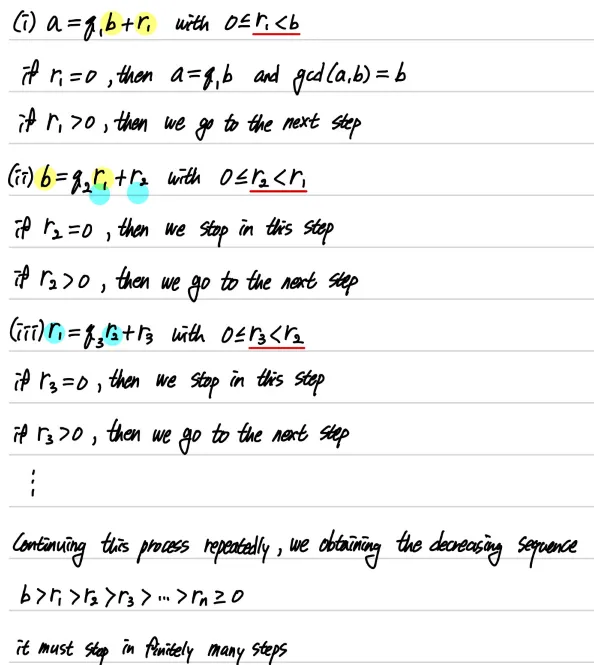
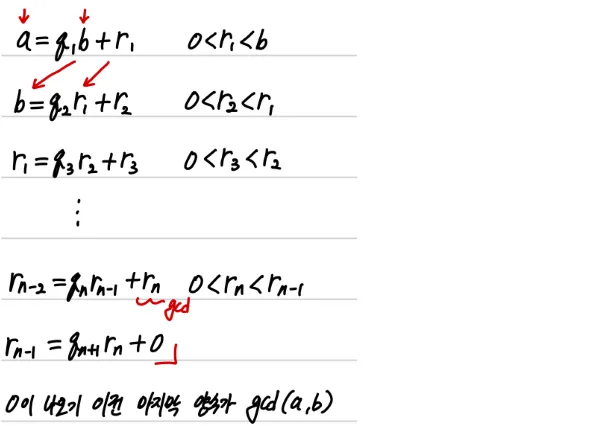
유클리드 호제법 계산 과정 1

유클리드 호제법 계산 과정 2

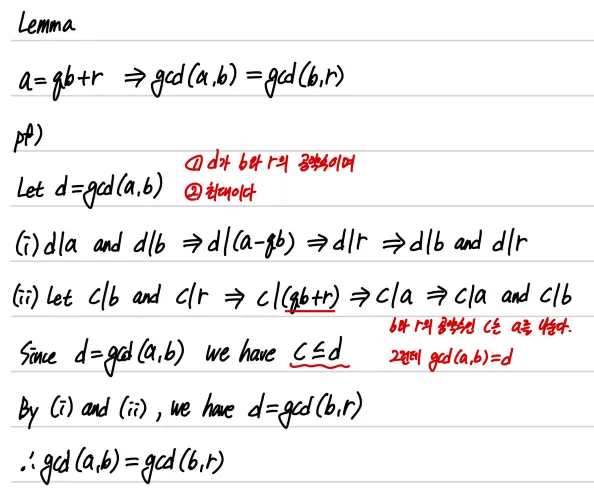
Lemma (will be proved)

a=qb+rgcd(a,b)=gcd(b,r)a =qb + r \Rightarrow gcd(a,b) = gcd(b,r)

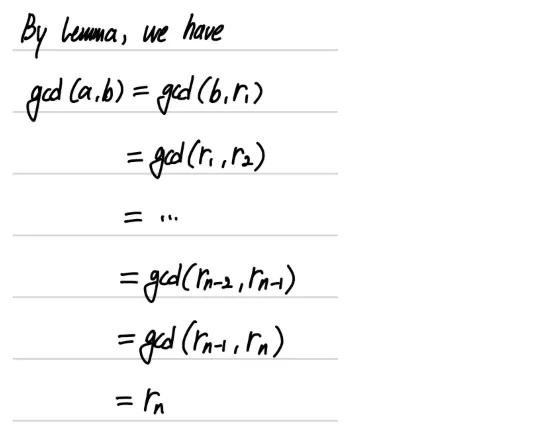
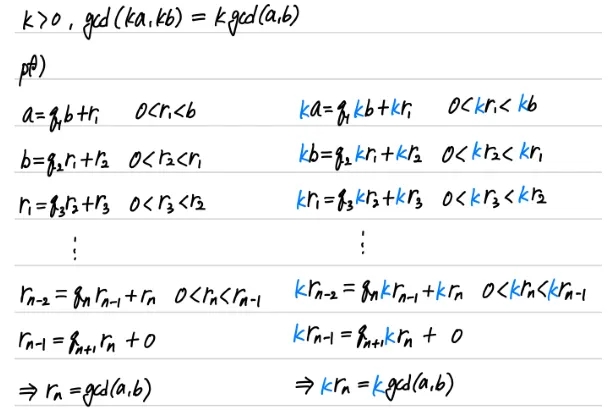
Proof of gcd(a,b)=rngcd(a,b) = r_{n}

유클리드 호제법 최대공약수 증명

pf

유클리드 호제법 정리의 증명

example

숫자가 클수록 모든 positive divisor을 구하기는 어렵다
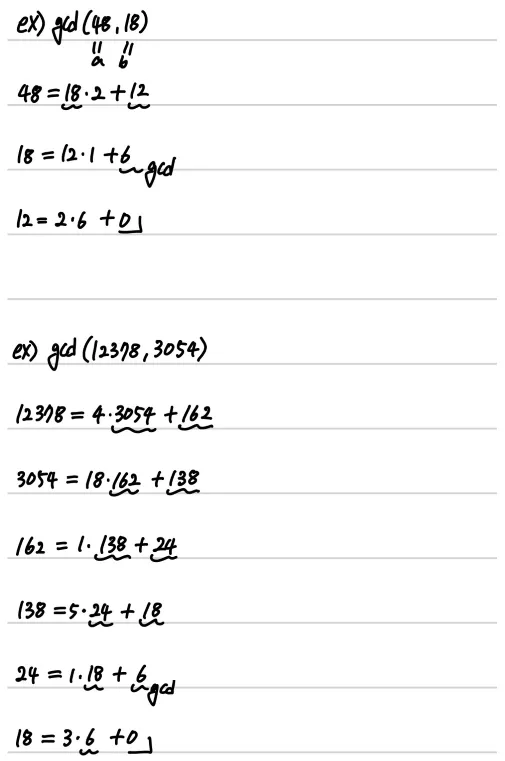
유클리드 호제법 계산 예제

정리

  • prove the Euclidean Algorithm
  • We can compute the gcd(a,b) using Euclidean Algorithm (even for large a and b)

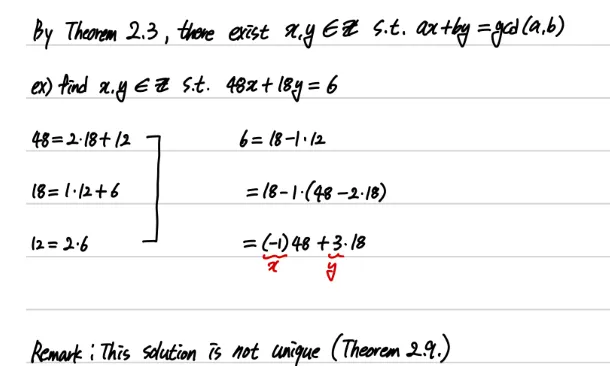
2.4.2 Find x,yZ with ax+by=gcd(a,b)x,y \in \mathbb{Z} \text{ with } ax+by=gcd(a,b)

유클리드 호제법의 응용

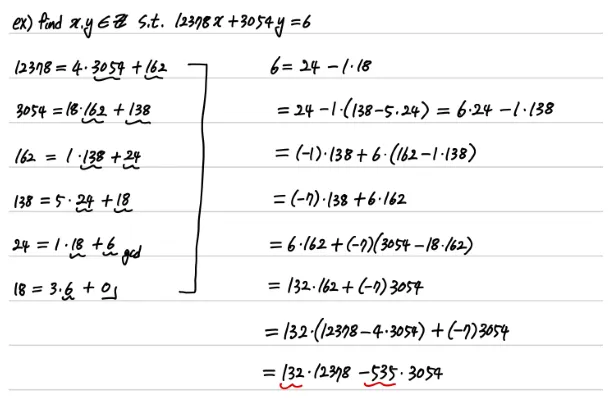
확장 유클리드 호제법 계산 과정 1

확장 유클리드 호제법 계산 과정 2

답중의 하나를 위의 방법으로 구할 수 있다.

Theorem 2.7
확장 유클리드 호제법 정리 2.7

Euclidean Algorithm 이용해서 증명함

정리

  • We can find x,yZ s.t. ax+by=gcd(a,b) x,y \in \mathbb{Z} \text{ s.t. } ax+by=gcd(a,b) using the Euclidean Algorithm

2.4.3 The Least Common Multiple

Definition 2.4

Given a,bZ(a0 or b0)a,b \in \mathbb{Z} \left( a \neq 0 \text{ or } b \neq 0 \right), the least common multiple of a and b\text{a and b} is the positive integer m satisfying

(a) ama \mid m and bmb \mid m (common multiple)
(b) aca \mid c and bcmcb \mid c \Rightarrow m \le c (least)

In this case, we write m=lcm(a,bm = lcm(a,b)

Theorem 2.8

gcd(a,b)lcm(a,b)=ab gcd(a,b) lcm(a,b) = ab

Corollary 2.8

For any a,bN,lcm(a,b)=abgcd(a,b)=1a,b \in \mathbb{N}, lcm(a,b)=ab \Longleftrightarrow gcd(a,b) = 1

Proof of Theorem 2.8

정리

  • We can write the definition of lcm(a,b)lcm(a,b)
  • We can prove the relation between gcd(a,b) and lcm(a,b)gcd(a,b) \text{ and } lcm(a,b)
Discussion

Comments