2.3.3. relatively prime

On this page
  1. Definition
  2. Theorem 2.3
  3. Theorem 2.4
  4. Corollary of Theorem 2.4
  5. 2.4.1
  6. 2.4.2
  7. Theorem 2.5 Euclid’s lemma
  8. Theorem 2.6 The Gratest Common Divisor
  9. 정리
  10. 문제

Definition

Given a,bZ (at least one of them is not zero), \text{Given } a,b \in \mathbb{Z} \text{ (at least one of them is not zero), }

a,b are called relatively prime defgcd(a,b)=1a,b \text{ are called relatively prime } \overset{\text{def}}{\Longleftrightarrow} gcd(a,b)=1

Theorem 2.3

Given a,bZ(a0 or b0), let d=gcd(a,b)\text{Given } a,b \in \mathbb{Z} \left(a \neq 0 \text{ or } b \neq 0 \right) \text{, let } d=gcd(a,b)
There exists x,yZ such that ax+by=d\Rightarrow \text{There exists } x,y \in \mathbb{Z} \text{ such that } ax + by = d

이전에 증명했었다. 지금은 d=1 인 case

Theorem 2.4

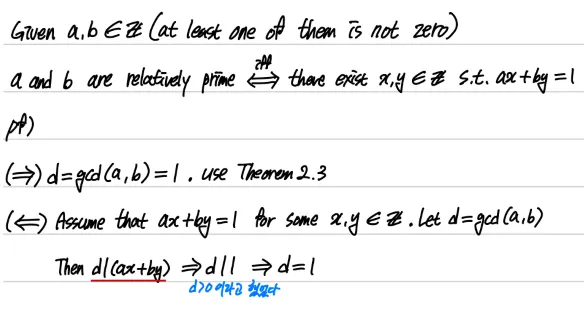
gcd(a,b)=1x,yZ s.t. ax+by=1gcd(a,b) = 1 \Longleftrightarrow \exists x,y \in \mathbb{Z} \text{ s.t. }ax+by = 1

서로소와 베주 항등식

Corollary of Theorem 2.4

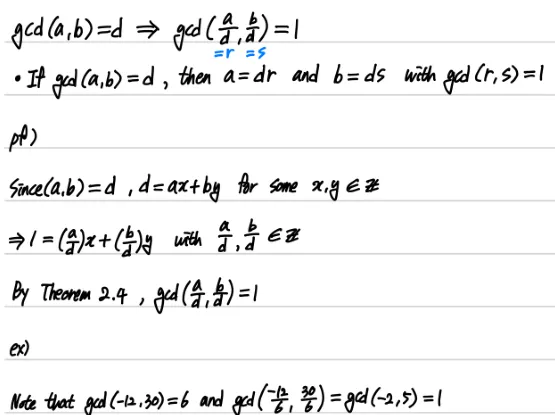
2.4.1

서로소 정리 2.4.1

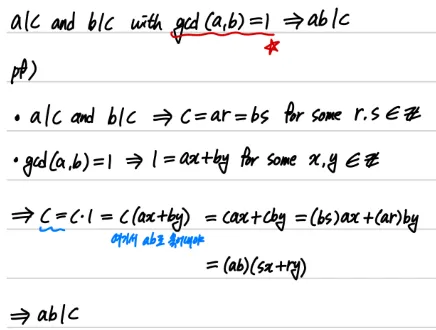
2.4.2

서로소 정리 2.4.2

  • The condition "gcd(a,b)=1gcd(a,b)=1" is necessary

Note that 624 6\mid 24 and 8248 \mid 24. BUT (68)24(6 \cdot 8) \nmid 24

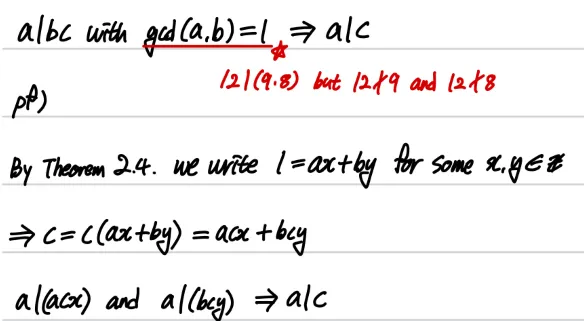
Theorem 2.5 Euclid’s lemma

유클리드 보조정리

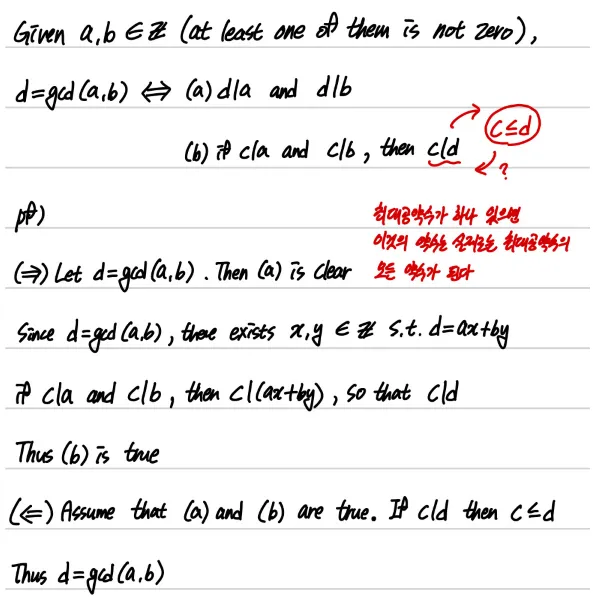
Theorem 2.6 The Gratest Common Divisor

최대공약수 정리 2.6

그래서 d=12d=12 였다면 원래 정의에서는 d보다 작은 값이 다 될수 있었는데, 사실 d의 약수 c=1,2,3,4,6,12c=1,2,3,4,6,12 만 생각하면 된다.

정리

  • definition of relatively prime numbers
  • gcd(a,b)=1gcd(a,b) = 1 \Longleftrightarrow there exists x,yZ with ax+by=1\text{there exists } x,y \in \mathbb{Z} \text{ with } ax+by=1
  • corollaries of Theorem 2.4
  • Euclid’s lemma

문제

꼭 풀어보도록 하자…

Discussion

Comments